Series: Explaining developer jargon for everyone else
Part 3 of 5
Before we can talk about APIs and endpoints, we need to talk about functions because an endpoint is really just a fancy function.
A function is the most basic way to group code together. It lets you reuse some logic multiple times without rewriting it every time. Functions have inputs and outputs.
If you’ve ever seen a math function like f(x) = x + 1, that’s exactly the idea. Give it an input of x = 1, and you get an output of 2.
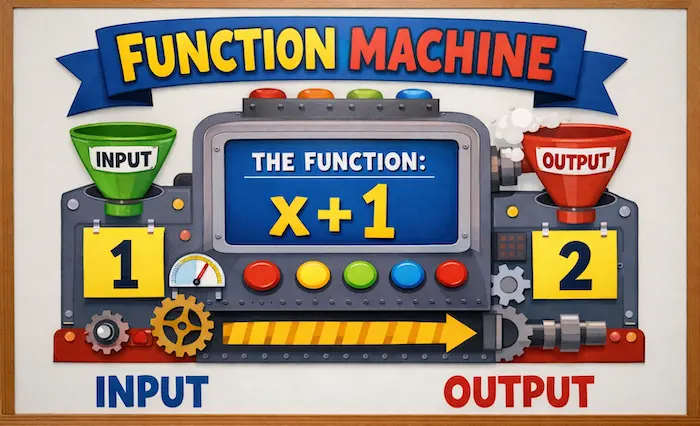
Put something in → does some stuff in there → a new, different thing comes out.
That machine is a function.
An endpoint is basically just a function that accomplishes one specific task. “Get me this document.” “Upload this document.” “Delete this user.”
You can think of each endpoint as one of those in-and-out machines; it takes some input, does something with it, and gives you something back.
An API is just a logical grouping of those endpoints, deployed together as a unit.
If an endpoint is a single machine, an API is a whole factory floor full of machines. Each one does a different specific job, but all working together under one roof.
In practice, when developers say “API” they usually mean an HTTP API, which means the endpoints are called over the internet. Your app sends a request to a URL (the endpoint), and gets a response back.
- Function / Endpoint → the in-and-out machine. One specific task.
- API → a group of those machines, deployed together and accessible (usually) over the internet.
So the next time a developer says “hit that API endpoint,” they just mean: send a request to one specific function that lives on the internet.